|
||||
|
January 31st, 2024 (4th ed)1 When designing a system, what should you optimize? If it is a user-interface or process, you should be minimizing clicks, or process steps. But for hardware-software systems, the answer is not obvious, and a common mistake is to fail to consider the end-to-end problem. This article explores what is involved in optimizing end-to-end in hardware-software systems. The goal here is to minimize the overall complexity of the system, i.e. of the triple hardware-software-user combination. The following remarks set the stage for our discussion:
 Between complexity and simplicity, progress, and new layers of abstraction. Continue reading this article…
AppendicesAppendix 1. The Essential Nature of ArithmeticThe following are extracted verbatim from the outstanding essay of A.D. Aleksandrov, A General View of Mathematics, specifically section 5, pp.17-19, on the Essential Nature of Arithmetic in [Aleksandrov/Arithmetic1956]. 1. How did the abstract concepts of arithmetic arise and what do they reflect in the actual world? 2. Why are the conclusions of arithmetic so convincing and unalterable? 3. Why has the abstract concept of number and arithmetic taken so long to arise? 4. What forces led to the development of mathematics? Appendix 2: The Invention of Writing: An Advancement of Bookkeeping1. When was writing invented? The earliest writing appears between 3500 and 3100 BCE depending on which of the proto-writing materials one is willing to admit. Regardless, there still between 500 and 1000 years before the first readable cuneiform dating to c.2500 BCE (the school texts of Fara). [Nissen/1986] Adam Falkenstein (1936) published ATU1: The Archaic Texts of Uruk, which recorded the archaic signs occuring in the first 620 tablets found at Uruk in the first three seasons of excavations there. In the 1980s, Hans Nissen, a student of Falkenstein, launched the Berlin Project that aimed to publish all texts found since Falkenstein’s publication. The difference was that since Falkenstein there was a group of texts the so-called “Lexical Lists” which went from 0.5% of known texts in 1936 to 15% in 1986 (50 years later) and were word-for-word ancestors of the ‘schooltexts’ from Fara (Shurrupak) and which are almost fully comprehensible. This has brought almost 70% of the archaic signs to be identified. (The remaining 85% of archaic texts are so-called economic or administrative texts, i.e. these are receipts, lists of expenses, of animals, of all kinds of goods, of raw materials.) [Nissen/1986] Why writing? “It was the need to control an expanding economic unit (the Eanna temple) that prompted the introduction of controlling devices better suited for managing large quantities of information than the human memory.” [Nissen/1986, p.324] Writing was an advancement from other innovations in managing complex economy, namely cylinder seals, tokens, clay envelopes (bullae), numerical tablets, ideographic tags, and finally numero-ideographic tablets, and ultimately their standardization into cuneiform. [cf. Hoyrup/1991] “Writing appeared as the final solution to a number of economic problems which had probably been accumulating for a long time.” [Nissen/1986, p.326] The evolution of writing over 1,100 years, from proto-cuneiform in Late Uruk period (3,100 BCE) to syllabic cuneiform during the Ur III period (2000 BCE). It took over 1,000 years to go from the first signs to the Ur III signs. (40 generations of 25 years each). LU2 A Lexical List of Standard Professions, from 3200 BCE (Uruk IV) through to the Fara schooltexts. Appendix 3: Birth of the Universe up to the Early Period of Life on EarthThe difference between science and mythology Every culture has its own creation story that provides the whys and hows behind the way things came to be. Science, too, is a creation story, with the difference being that its whys and hows are connected in a chain of evidence that ties every claim back to principles that are in turn backed up either by experiment or are the result of observation with astronomical instruments or mathematical calculations based on physical laws, thermodynamics, and cosmological equations. [NAS, 1999], a 48pp book from the U.S. National Academy of Sciences, is an excellent comprehensive presentation, useful for its comprehensive approach, although it is by now dated. The current scientific view of the story of the universe is based upon full-field (all-sky) astrophysical observations made between 2009-2013 by instruments aboard the Planck spacecraft (European Space Agency) positioned almost 1 million miles from the earth1 and summarized in Chronology of the Universe [Wikipedia, 2023] The Current Scientific View What we believe happened depends on which of the two main cosmological theories we go with: lamba-cdm or mondian cosmology.  Birth of Universe 13.8 billion years ago (bya). Source: Wikipedia: Timeline of epochs in cosmology Theory 1 (lambda-cdm): if we assume the existence of a massive amount of, as yet undetected, dark energy (Lambda) and cold dark matter (CDM), then the Lambda-CDM model predicts, based on an analysis of the anomalies present in the cosmic background radiation at microwave and infrared frequencies, that the Universe formed in a “big bang” event 13.8 billion years ago (bya).2 Now the Big Bang event itself was not an explosion (contrary to popular portrayal) but rather the abrupt appearance of extraordinarily rapidly expanding (inflating) universe in which spacetime itself (though not the matter in it) was stretching many times faster than the speed of light (10 light years in a tiny fraction of a second)3, and at extremely high temperatures (10^15 degrees Kelvin).4 Another tiny fraction of a second later, and the universe, now with its particles dispersed quite uniformly across the vastly inflated universe, entered hypercooling. during which time, the fundamental forces began acting and sub-atomic particles formed as described by the Standard Model of particle physics. Over the next 20 minutes, sub-atomic particles combined to form photons (light energy) and matter, mostly hydrogen and helium, creating a super-hot (10 billion degreees Celsius, or 10^9 Kelvin K) glowing fog universe. This ambient energy was captured over the next 380,000 years in the formation of molecular bonds. The earliest molecules were hydrogen gas (H2) and, after much searching based on theory, also helium hydride has now also been identified as occurring naturally in space, confirming its place as one of the earliest molecules in the chemical evolution of the universe.5 The formation of molecular bonds over this period time enabled the universe to cool down a million-fold to a less hot 3000 K (c.2700*C), and become transparent. (Reminder, the Kelvin temperature scale is the same as Celcius except it is offset by 273 degrees, so that 0 Kelvin is absolute zero = -273C.) It would take a further 10 million years (looking back in time this is still more then 13 billion years ago) before the early universe would cool a further 10-fold to reach the relatively pleasant 300K/27*C without any radiation heating from stars which had not formed yet. While these temperatures are suitable for liquids and therefore in principle for life as we know it (the so-called habitable era of the universe), in fact the dark, starless universe was not chemically rich enough yet to support either. Until the formation of stars there would have been very few elements heavier than lithium (3rd in the periodic table). Liquids and life (as we know them) require heavier elements which can only be forged through nuclear fusion, thus, in the nuclear furnaces of stellar nucleosynthesis. This is one theory. Theory 2: The other prominent alternative is a modified theory of gravity (MOND/MOG) that diverges from Newton/Einstein dynamics at very low accelerations, i.e. on the edges of galaxies or in the interaction between binary star systems. The gravitational modification due to Milgromian dynamics or Modified Newtonian Dynamics (MOND) is that for very low accelerations, e.g. on the scale of galaxies, the Milgromian law of gravity is inversely linear with distance instead of the inverse square law that holds within the solar systems or on earth. Considered another way, we might say that force is equal to the mass times the square of the acceleration as in the usual case. The complication is that, until 2021, MOND/MOG theories have not been able to fully explain the cosmic background radiation, nor the perceived homogeneity in distribution of matter throughout the universe, in every direction we look at (the isotropic property of space). As of 2021, MOND theories have been built that explain observations in the cosmic background radiation, providing the possibility of a MONDian cosmology. Star formation6 began after 100 million years, ending the so-called “cosmic dark ages”. Nuclear fusion reactions in the stars began after 300 million years forming the heavier elements of the periodic table, carbon (6), nitrogen (7), oxgen (8), sulfer (16), which are needed for carbon based life and for liquids. The first galaxies of stars appeared at 400 million years. Could life have existed in such a universe once stars had formed? Liquids (organic, inorganic, and water)7, contain elements made in stellar reactions which would have been available after star formation. Recent research (Loeb/2021) aims to shed light on whether liquids other than water (ethanol, propane, methanol, ammonia, hydrogen sulfide) could chemically sustain life to attempt an upper bound on the date when life could have started in the universe. Our Milky Way galaxy began to form after 700 million years, and would take the next 4.5 billion years to evolve until it acquired its spiral arms through galaxy collision (8.7 billion years ago bya). It would take a further 4 billion years for our solar system to form (4.6 billion years ago).  The First 9 Billion Years. From the Birth of the Universe (13.8 billion years ago) to the formation of the Milky Way (760 million years after birth) to the start of the Milky Way spiral (5 billion years), to the formation of our solar system (9.2 billion years, 4.6 billion years ago) Source: Wikipedia Matter Era of Cosmology Before we come to the formation and development of our solar system, let’s take a brief moment to look at the Milky Way (our galaxy): the edge of the Milky Way is about 1 million light years away from us. We are about 27k light years away from the center of our galaxy (i.e. we are off-center). At the center of the galaxy is a giant black hole Sagittarius A*, around which objects are orbiting at an astonishing 30% of the speed of light. Closer to us is the nearest start system Alpha Centauri, of which Proxima Centauri is the nearest star to us, invisible to the naked eye, about 4.2 light years away, and would take 73,000 human years to get to with current thruster technology. Our solar system, including the Sun, the planets, and the Earth-Moon system, formed during a tumultuous 100 million year period between 4.6 and 4.5 billion years ago (bya). Taking a closer look at our solar system, with current thruster technology, it takes 9 months to journey to Mars and 1 year to Jupiter. Using our fastest spacecraft New Horizons, which can travel 30k miles/hr, or 1 million miles per day, it would take about 10 years to reach Pluto which is 3 billion miles away (a year of acceleration to top speed, a year of deceleration, and 8 yrs travelling at top speed). Compare this with the speed of light: 5 hours Sun to Pluto, 8 minutes Sun to Earth. Increasing our direct experience of the solar system requires further progress in robotic or manned space exploration. Open questions remain: Is our Solar System in a Magnetic Tunnel? Telescopic observations match an analogy with camera observations inside a tunnel< It is believed that the early earth was molten and then cooled, forming a crust and holding surface liquid water creating oceans. During this time it is also believed that gravitational instabilities from the heavier planets may have pulled large numbers of asteroids from the solar system’s outer belt into the inner solar system where they collided with the Earth, moon, and many of the planets, leaving extensive cratering on planetary bodies and moons that did not have a thick enough atmosphere to protect themselves (Late Heavy Bombardment period) (e.g. our own moon). Where did the water come from for the earth? Recent research finds that hydrogen-rich solar wind and oxygen-rich dust in the solar system can combine with irradiation from the sun to create flowing water that could have streamed onto early barren earth. What we believe today: Earth got its water from asteroids.8 Faint Sun paradox for early life. If the early Sun was smaller and dimmer, then the early earth would have been much colder. Were conditions really suitable for life on the early earth? greenhouse gases may have made the early earth habitable even when the early sun was too faint to warm it (faint sun paradox) The first evidence of life on Earth are single-celled organisms (bacteria) which appear in the fossil record 3.8-3.7 bya (Early Archaen Era). Life evolved slowly over the next 3 billion years, along with major upheavals in the earth’s structure, atmosphere, climate, and surface geology. After the first billion years (i.e. 2.7 bya), simple multi-celled organisms appeared (algae, amoebas, mold, fungus). It took another 700 million years (to 2bya), for genetic material to begin being exchanged amongst prokaryotes. And from this point, another 900 million years (to 1.1bya) for the first sexually reproducing multi-cellular organisms to appear. It would take another 600 million years (to 538 mya), before the beginning of a radical acceleration of life’s diversity, the so-called Cambrian Explosion. (see Appendix 4 below).  The first 4 billion years on Earth (4.6 bya): evidence of earliest life found 3.8bya, reproducing multi-celled organisms by 1.1bya, the first animals (sponges) around 670mya, and the first arthropods (invertebrates) by 570-555mya. Sources: GeologyCafe.com and Unknown As astronomical observation capabilities improve and we find more examples of earth like planets (e.g. TOI 700 e) and think that perhaps we might move to other planets, it’s worth remembering why we should not assume that there’s a planet B waiting for us: it has taken 3.2 billion years of joint evolution of earth and life, each impacting the other. Where did the phosphorus come from in the early Earth that forms an essential element in DNA/RNA? Research suggests the biological phosphorus was releaesed by lightning strikes on a type of surface rock, a quintillion strikes during the chaotic period of the Earth’s development 4 billion years ago, that was followed by surge of life. Evolution of higher complexity during the earliest stages of life on earth appears to have been driven by symbiosis. The earliest cilliates apparently absorbed instead of eating a nitrogen fixing bacterium, and developed an organism that can survive without oxygen by metabolising nitrogen. (Article here and here). Appendix 4: The Acceleration of Living Diversity (Cambrian Explosion) to the Dawn of Humanity
This flourishing of life in its diversity came to an end 252mya with the most severe mass extinction to that point (the Late Permian extinction event) as a result of which 81% of marine life and 70% of land vertebrate life disappeared. The causes are thought to be massive volcanic explosions releasing 12x more carbon dioxide into the atmosphere than has occurred during the past 250 years due to the industrial revolution, driving acidification of the oceans, destruction of the ozone layer, increase in solar irradiation, and a global temperature rise of 8*C. It would take 20 million years before land life picked up again, stimulated by another major jump-start event which occurred 232 mya during the Carnian period. The greenhouse conditions on earth led to to 1-2 million years of heavier rainfall on what had been bocome an arid, dry Earth, accelerating life once again and boosting diversity. This was the Cenozoic period (252-66mya) during which occurred the rise of large life on land and the dominance of the dinosaurs from 200 mya (the Jurassic period), including recently discovered super-massive dinosaurs. The dominance of the dinosaurs lasted until the meteorite strike 66mya throwing up particulate matter in the atmosphere reducing sunlight reaching the surface and plunging the earth into a colder, darker phase. This triggered another mass extinction event that extinguished the dinosaurs, cooled the tropical earth. While mammals co-existed with dinosaurs at the end of the Jurassic period, they were small and filled specialized ecological niches. But mammals survived the meteorite strike that killed off the dinosaurs and thrived in the new, cooler, modern habitat, eventually becoming dominant. Primitive primates also existed from 66mya, migrating and evolving to the lineage in Africa c.13mya from which hominids would eventually emerge. This was also the time of remarkable changes in the surface topography due to active plate tectonics (watch this simulation at 0.25x speed showing plate tectonic movement over the past 1 billion years). When we think about the remarkable diversity of life currently on earth (est. 1 trillion species overall, est. 8.7 million eukaryote species, of which only 1.2 million are known, mostly insects), and the even larger biodiversity lost (est. 5 billion extinct species), the question arises: if we could seed life in the universe using comets (panspermia), should we? Was the Cambrian explosion the result of such a seeding event?  Next 500 years, from the Cambrian Explosion (500mya) to the extinction of the dinosaurs (66mya) Mass extinctions in the past have a lot to teach us about parallels to the present. The Rise of Primates and the Dawn of HumanityIn the aftermath of the dinosaurs about 66mya, mammals flourished. There is evidence that primitive primates already existed at 66mya. The African primates from which our lineage descends appeared (13 mya). Unknown common ancestor of chimps and humans  Primates share common ancestor with humans, from 8mya A look at the evolution of primates and hominids: grasping hand vs. dextrous handWherever we look, we see affirmed the principle “Natura non facit saltus”, i.e. “Nature makes no leaps”. Everywhere there is gradation, diffusion, similarity with minor differences, advancement happening gradually through time. Wherever some jump, looking closer, the jump is found rather to have passed through more gradual stages that were not apparent in first appraisal. The last known bifurcation between primates and hominin species was c.8mya when the evolutionary pathway of chipmanzees and humans diverged. At this time, the climate was warm, primates and hominins lived in the treelands on the edge of the growing savannah, in social structures. Recent work has suggested that the simian hand with relatively shorter thumb length and longer fingers, evolved away from the hand shape of the last common ancestor of humans and primates which had relatively long thumb lengths. This simian “grasping hand” would have been i.e. better adapted for swinging through trees, for which a long thumb would have gotten in the way. The dextrous hand by comparison with its relatively longer thumb, closer in size to the fingers, allows more dextrous hand work, at the same time making it less easy to swing in the trees, driving hominins to spend increasing amounts of time on the ground. For a comparative understanding of the complexity of the evolved dextrous hand: By 6-7 mya, the earliest bipedal hominins have appeared in Africa (Sahelanthropus, Orrorin, Ardipithecus). Bipedalism has the advantage of hands free to hold tools or possessions, and the ability to see further. It is believed that bipedalism arose first using tree branches to guide bipedal ability and then free-standing on the ground. By 4mya, australopithecus was walking comfortably on 2 legs. Tool use is another area where there significant gradation and diffusion and fewer apparent leaps the closer that we observe non-human tool use. Looking only at primates, we find that they use and make tools from natural resources: twigs and sticks for “termite fishing”, large leaves for wrapping or carrying, sticks for striking objects out of reach, even sharpening them for use as spears for stabbing and killing small mammals for food hiding in tree holes (2007), and unworked stones for cracking open nuts (hammer and anvil mode), hammering or throwing. Interestingly, we even see gender difference in chipmanzee use of inanimate objects, with female chimps using sticks or logs as dolls (2010 study). With primates able to develop and use tools despite their more awkward grasping hand (long fingered, short thumbed), it reasonable early hominins did similarly, with more capability from their more dextrous hand design (shorter fingered, longer thumbed). The complication in all of this is concluding who developed and used the tools archaeologically. Unworked stones, for example, can be used for pounding, crushing, grinding, or to throw as a weapons, and yet stones used in this way are indistinguishable from naturally stone. Thus, the point where stone begins to be worked undeniably into tools with edges, becomes the earliest date from which we can say there is artifactual evidence for tool use, beginning 3.3 million years ago and marking the start of the Old Stone (Paeliolithic) Age. (see Appendix 5 below).  Hominin to Human (Part 2): Last Common Ancestor (LCA) concept, and Family Tree of Hominins  Hominin to Human (Part 1): Skeletal and Cranial comparisons  From 66mya to the Present. Life in the Cenozoic era – Tertiary and Quaternary Period, from the Paleocene to the Holocene Epochs. Appendix 5: Paleolithic (Stone Age) Culture from Lomwecki (3.3mya) to Shanidar (50kya)The Paleolithic covers the time from the first stone tool wielding hominids (3.3 mya, Lomekwi3 site, W. Turkana, Kenya) until the end of the four ice ages (2.6mya-12kya). Primary subsistence mode was hunter-gatherer. A recent site which included Neanderthals and Homo Sapiens is Shanidar Cave (65,000 BCE), a Middle Paleolithic (Mousterian culture) site in the Zagros mountains of Iraq/Iran/Turkey border. The last paleolithich stage is Upper Paleolithic (from 50,000 BCE) By 4 mya, we have comfortably bipedal hominins (Austraopithecine) in East Africa (Tanzania, Kenya, and Ethiopia). The appearance of worked stone tools in the archaeological record marks the beginning of the so-called stone age (paleolithic period). This occurs by 3.3mya, when we have the earliest archaelogical evidence of stone tools arising from a worked process (i.e. non-natural) (Lomekwi3 site in West Turkana, Kenya)[Harmand, 2015, Nature], pre-dating both the earliest Homo species and Oldowan tool culture by 700k years. These earliest stone tools with sharp edges were created through blows delivered stone against stone and found at the Lomekwi site c. 3.3mya. However, we cannot conclude from this alone that they were made by hominins: [Proffitt, 2023] provides a plausible alternate hypothesis. Proffitt shows that wild macaques use stones to crack nuts (hammer and anvil mode) the result of which creates accidental fractures that are indistinguishable from Oldowan tools attributed to hominin production. Whether the tools from Lokemwi are the result of primate tool use or hominin tool use is to some extent immaterial. The point is that the use of stones for tools was now clearly deliberate. One possibility, the cracking of nuts using stones could have led to the accidental discovery of sharp edges followed by the intentional repetition of the behaviour now specifically for the purpose of obtaining the blades. If we set aside simply struck stone tools, then the next evidence of an increase in sophistication in stone tool technology is 1 million years later, c.2.3mya, from the same W. Turkana area at the Lokalalei site [Delagnes,Roche, 2005]. These are bladed stone tools of Acheulean type, i.e. bifacial edges that show reworking to improve the blade (mode 2 tools) through a process of “knapping” or chipping away of small flakes. Stone tool cultures – the shared knowledge of tool manufacture and useFundamental to the sustained development of stone tools is the notion of culture, or the transmission of knowledge (in this case lithic technology) between individuals. Here too animals display capability for the social transmission of behaviour, or culture. Taking a look at stone tool sophistication, we can delineate five stone tool cultures stretching from simply struck stone tools from Lomekwi (c3.3mya) through to polished stone tools fixed in wooden hafts (14kya), (see Fossil & Tool Gallery). These stone tool cultures are classified according to the complexity required for their manufacture. “Simply struck tools are Oldowan (mode 1, unifacial). Retouched, or reworked tools are Acheulean (mode 2, bifacial). Retouching is a second working of the artifact. The manufacturer first creates an Oldowan tool. Then he reworks or retouches the edges by removing very small chips so as to straighten and sharpen the edge (this is called knapping the stone). Typically but not necessarily the reworking is accomplished by pressure flaking.” (Wiki, Oldowan). Stone knapping is not easy, nor was it likely to have been injury free. [Gala, 2023]
Telling the story:
Anatomically Modern HumansSo what makes humans unique? It appears to be a series of evolutionary adaptations that allowed humans to exploit and perfect a particular ecological niche. These include:
With a dextrous hand, we have been able to fashion useful, precise tools. With the ability to throw, we have been able to hunt with spear thrown 100m with hard and with accuracy, enabling the capture of large and nutritious food, fueling growth of body and brain. The loss of body hair enabled long distance running without overheating, also useful in the hunt. The voicebox allowed a pallete of sounds from which with symbolic association could create rudimentary and then more complex language. Writing and reading allowed the recording of knowledge, its refinement, and dissemination beyond the scholar both in location and time. Interestingly, it is NOT what we normally think of. When we consider what makes us human as distinct from animals, recent research has shown that each of the below abilities which we formerly thought were uniquely human, the capabilities have been observed in animals [Hauser]. These include the abiity to:
Can animals think, reason, learn, communicate, feel, grieve, love? All of the above. The gorilla Koko could use 1000 words in sign language, and could understand 2000 words of spoken English. Why couldn’t she speak? Gorillas have physiological limitations in their vocal cords and tongue muscles that prevent the production of sounds that humans can make for controlled speech. But that doesn’t limit their faculties for thought and a full emotional range. The Development of Anatomically Modern Humans Human Evolution Timeline, from Neanderthals 300kya to the emergence of writing 5kya (c.3000 BCE)
 Artists conception of communal living in Shanidar cave (ca. 50,000 BCE) The history & learning of craft:
The story so far know is: Australopithecus emerged c. 6-7mya, as first bipedal ape-like hominin. It took a long time for another change, 2.3mya with homo habilis, still ape-like. Then 1.8mya we have the earliest homo erectus, a human like fully bipedal hominin with smaller teeth, a body like ours, and an enlarged brain. The tipping point for this change may have been the controlled use of fire for on-ground night-time protection, warmth, and cooking (requiring smaller teeth/smaller gut). From here there branch off several homo species including neanderthals (origin 800-400kya). The final stage was the emergence of homo sapiens, our own species, discovered about 300kya in Morocco, or 200kya in Ethiopia. With the development of fire, and the ability to hunt cooperatively, and access to higher calorie intake, man’s brains became larger. The hypothesis is that tool use and the desire to carry ones tools, meant more and more walking on two legs, and less and less 4-legged walking or traveling through trees. Three more species of humans fill out the story: By 315kya, Homo sapiens had emerged based on fossil discoveries at site in Morocco and by 230kya at the Omo 1 site in the Ethiopian portion of the East African Rift Valley. Homo sapiens neanderthalis appear about 130kya, and Homo sapiens sapiens (anatomically modern humans) appear about 100kya. From 100kya onward, most of the Earth has been populated by hominid ancestors. The last glacial period began 110kya and lasted to 12,000 BCE (14kya). The Influence of Ancient Climate on Human Evolution Correlation of major climate fluctuation with emergence of human species Climate is the result of interactions between surface topography, ocean, atmosphere, and geological processes. It is both influenced by and itself greatly influences terrestrial life. In particular, climate and ecosystem changes are believed to have driven systematic migrations and explain (1) hominin ape ancestors origins in Western Europe migrating through Eastern Europe, Mediterranean, and thence to Africa to African apes and to early man in the savannas of Africa; (2) Homo erectus moving out of Africa into Europe, then leaving Europe for Northern Africa during a hundred thousand year cold spell, and re-entering Europe again as Homo Sapiens; (3) evolution of human species has been punctuated by major climate variation.
Paleolithic migrations Hominid Migration out of Africa, 1.7mya to 1.4mya  Hominin Migration, 500kya to 125kya, source: AtlasOfTheHumanJourney.com Reflections on climate health of today’s earth: Appendix 6: Culture in the Near East: From Mesolithic (during the end of the last ice age, c 18kya) to the Neolithic (rise of sedentism)By about 50kya, a wave of anatomically modern humans (homo sapiens) left Africa and moved through the Fertile Crescent (Map of Pre-historic sites) In this early period (48kya-35kya), we have both Neanderthal and Homo Sapiens occupying the same region, with the Neanderthal skeletons of Shanidar Cave in the Zagros mountains providing possibly the earliest evidence of human assault on Neanderthals. The Skeletons of Shanidar Cave, in the Zagros mountains of Kurdistan in northern Iraq, are Neanderthals from 65kya to 35kya. 10 nearly complete Neanderthal skeletons provide a remarkable picture. Neaderthals cared for their wounded and buried their loved ones in graves. There is evidence of murder of `Shanidar Three’ by a low-mass, low-kinetic energy projectile weapon, either by fellow Neaderthals, or by projectile-carrying homo sapiens who had entered the region. In contrast with the killing projectile, Neanderthals used heavy huntings spears thrust with great force at close range into their prey (large mammals). Humans had mastered lighter projectile spears, throwing these deftly and with some accuracy from further away. (Article 1, Wikipedia: Shanidar Cave, Article 2, Article 3). Shanidar, one of the few continuously occupied caves from 50kya to the present. [Solecki, 1979]
Kebaran culture in the Levant from 18,000 BCE Natufian culture in the Levant from 13k bce to 9.7k bce at the end of the last glacial stadial (Younger Dryas). Natufian culture was semi-sedentary in the Levant, wandering around Jericho with its abundant springs. After the last (fourth) ice age (ending c.12,000), transition between hunter-gatherer to increasingly sedentary subsistence mode. Pre-Agricultural Sites: Starting to experiment with taming nature: wild cereal cultivation, domestication of the dog, domestication of other animals (sheep, goats), mix of semi-settled and nomadic herders. First evidence of bread 14,500 BCE and beer 11,000 BCE.  Artists conception of Mesolithic life, combination of hunter and gatherer lifestyle. References: Charvat/2002, Nissen/1988 By 14kya, the Paleolithic era is ending with the last ice age giving way (c.12kya) to the Younger Dryas inter-glacial period (holocene warming period c.10kya) lasting to the present time. By 14mya man has mastered the bow and arrow, and we have evidence of domesticated dog living amongst men at the Palegawra site (17kya) in the Zagros mountains. The change in climate and habitat triggers the start of the Mesolithic epoch in the transition from Paleolithic (nomadic hunter-gatherer) to Neolithic (settled farming). As the last ice age receded around 12kya, the environment began to yield more plentiful food sources for hunter gatherers. In the Mediterranean and Near East, wild grasses and cereals (wild barley, einkhorn and emmer wheat) increased, accompanied by lentils and various pulses. Hunting moved from indiscriminate killing of a wide range of animals to a focus on a few species, particularly wild sheep, wild goats, and onager (wild donkey), supplemented less intensely by deer, wild boar, wild cattle, hare, wolf, fox, various birds, and other small mammals. Gathering was turtles, hedgehogs, snails, other molluscs, and plant food. For tools, they processed stone, bone (awls, knife handles, etc.), wood. To form axes, they used bitumin, a naturally occurring sticky tar, to attach stone or obsidian (black volcanic glass) blades into notched handles. Stone tools were typically made of chert or flint, obsidian or quartz (hardest material)
Even in this period of plenty, there is evidence of violence between human beings. By 11kya, they started to settle down in semi-fixed homes and experiment with mixed mode living — hunting, gathering, herding, and with wild crops. By 10kya, man had domesticated other animals, not unsurprisingly first sheep and goats, given the heightened contact through hunting, and then cattle. By 9,500 ya, evidence exists of domesticated pigs. By this point, housing was kept scrupulously clean, with lime plaster or clay interior walls, lowered floors, spiritual or ritual objects – statuettes, grave goods, body ornaments (necklaces, bracelets, rings). (Charvat 2002: 13)
New Stone Age (Neolithic) and Rise of SedentismNow we enter the Neolithic period, in the Near East this is from 9500 BCE onwards, after the end of the Younger Dryas, last glacial period. In agriculture there is experimentation with emmer wheat and einkhorn wheat, also cultivated peas, lentils, six-row bread wheat, oats, rye, linseed, and flax. They gathered wild cereals and also pistachio nuts from the highland woods. Some of the dwellings (e.g. at Umm Dabahiyah) now have “fresco paintings geometrical patterns and figural scenes (an onager frieze, a hunting scene)” (Charvat 2002:19) — fresco paintings are with colored powders applied to fresh plaster so that upon drying, the painting is an integral part of the wall. There is pottery, and ornamental decorations on pottery, houses with complex structures, including stairways for roof access, kilns for firing pottery, textiles and woven baskets. In agriculture there is artificial irrigation leading to larger crop yields (sites Choga Mami and Tell es-Sawwan inter alia). There is also clear evidence that Neolithic peoples were experimenters, cross-breeding cereal grasses to obtain domesticated variations that are in use to this day (four-row emmer wheat, six-row variations, with non-shattering stems in order to preserve the grains when harvesting). Charvat 2002:30 This was their main achievement – the advance and experimentation in securing additional food sources and improving and perfecting these through genetic interventions. Dogs were used to assist in both shepherding and hunting. As shepherding added more species (goats, sheep, cattle, pigs), hunting targets changed away from wild goats to gazelle and onagers, presumably because wild goats would be added to the herd. Gazelles and onagers are harder to hunt, requiring the coordination of numerous hunters with a single purpose. They also consumed more fish, mussels, turtles, and crabs. The settlements consisted of several houses, in some cases (Tell es-Sawwan) with a fortification ditch (3m deep, 2.5m wide) surrounding the houses, together with a rampart with buttresses (reinforced defensive walls). Houses were built of clay bricks, sometimes formed in molds, and the floors bore an occasional coating of bitumen (tar) or gypsum, otherwise reed mats, or stamped earth. Some of the village streets were paved. By Neolithic time, civilization was complete — societies had structure, religion, economic specialization, surplus food, art, and community. Planting and harvesting of grain was in place by 6900-6000 BCE.
One wonders if in the Neolithic times ideas of slavery led to raids on nearby settlements in order to coerce others to carry out food-producing work. Lifecycle of lambs and sheep: “Lambs are born around Christmas (for confirmation by the Near Eastern data see Wright, Miller and Redding 1980, 271; Wright, Redding and Pollock 1989, 108–109; Hruška 1995, esp. pp. 82–83) and in May they are usually grown enough to walk even over heavy ground and to be weaned so that sheep can be milked from that time on. In May the shepherds with their herds usually ascend the summer pastures whereupon the sheep are sheared and new wool employed to settle all accounts, debts and obligations that the shepherds or their masters might have incurred before, the season of cheesemaking following in the months of June and July. (Charvat 2002:39) There is some evidence that Neolithic cultures were migratory, moving seasonally between lowlands (winter) and highlands (summer), and taking advantage of whatever combination of subsistence methods worked in each circumstance. So there was agriculture, herding, hunting, gathering, but looks like there may have been migrations twice a year, (Charvat 2002:47) I.e. the sites were permanent but the people in them were not (Charvat 2002:40) Non-nomadic domesticates are the pig, which cannot travel long distance. Another sign is larger cemeteries indicating territorialization of human communities. (Charvat 2002:39)  Homo Sapiens migration – from Paleolithic to Neolithic, 10,000 years onward Genetic analysis shows it was the same peoples who settled the Polynesian Islands, including Easter Island, between 830 and 1360, over the course of 17 generations (30 years per generation). Each of these 21 islands has a similar ancient relic/megalith culture, and speak the same language. Appendix 7: Domestication of Animals Timeline: The Domestication of Animals. (Source) Others:
Appendix 7b: Foraging Foodstuffs: What the Wild would have held for ancient hominins and still holds for us today
Appendix 8: Near Eastern Cultural History: from pre-Pottery 7500 BCE through to Uruk city state period 4000 BCEList of all settlements, villages, and cities  Early Settlements in Near East, Paleolithic Sites (Shanidar mod. Zawa Chemi, Pelegawra) and Mesolithic Settlements c.10000 BCE (Natufian) to 7500 BCE (Pre-Pottery: Jericho, Gobekli Tepe, Cayonu, Catalhoyuk, Jarmo), to the Ubaid cultures (Samarra, Hassuna, Halaf, and Ubaid) and the start of the Bronze Age (Eridu, Uruk, Susa)
Culture around settlements, herding, farming, but also transhumance seasonal migration between lowlands and highlands. Type sites: Jarmo (7090BCE), an agricultural community of 150 people, or 25 houses, in the foothills of the Zagros mountains during the early Neolithic. Jarmo has evidence of agriculture, animal husbandry (sheep, goat, pigs), domestication of emmer and einkhorn wheat, barley and lentils, foraging of nuts acorns, pistachios, and early pottery.  Artist conception of Neolithic lifestyle. Bonkuklu Hoyuk, a site from 8500 BCE, small site Catalhoyuk in Anatolia, Turkey is dates from c.7500 BCE and is interesting as it was a proto-city with permanent settlement homes for between 5,000 and 7,000 individuals. (Compare to Jarmo village which had 150 homes.)  Artists conception of Ubaid life (unwalled settlements, communal labor, irrigation agriculture, copper supplementing stone and wood tools)  Ubaid period cultures, c.6000 BCE onwards.  Uruk City, founded in Ubaid 1 (Eridu) period 5,000 BCE as two temple sites, Eanna (to Inanna) and An, consolidated into a single walled urban site, eventually with an intricate inter-city canal system allowing heavy goods (wood, stone, etc.) to be brought into the city by boat from outposts, colonies, and distant trading partners (Venice in the desert) For history after ED period, see Part 2: The Mathmatics of Uruk and Susa, Appendix Bibliography & Further ReadingMesopotamian Mathematics: From prehistoric metrological tokens to writing and the earliest recorded mathematical practice (3200 BCE and onwards)
Neurological Studies of Animals, and the Cognitive Precursors of Mathematics History Succinct, 8-page summary of Mesopotamian history. Detailed description, based on archaelogical finds, of how the Near East went from Paleolithic to Mesolithic to Neolithic to Chalcolithic, before arriving at the Uruk period of city states. Each find site is reviewed in detail, and an interpretation is given covering all aspects of the associated culture (material conditions, social practice, art and ritual, modes of sustenance, food and commensality, individual work profiles, housing conditions, etc.) Provides an account, written toward the end of the Sumerian period, and before the conquest by Babylon, of the Sumerian lineages, from Eridu to the flood, to Kish and Uruk (Gilgames), to Ur, to the Akkadian conquest (Sargon), the Sumerian reconquest Ur III, and finally to Isin. Here the King List stops c.1753 BCE. What we know is that within 50 years (and one more transition to Larsa), the dissolution of the Sumerian dynastic lineage would occur with the conquest by Babylon under Hammurabi, a brother of the next to last regent of Larsa (Warad-Sin). See Uruk and Susa, appendix for details. Gives a detailed history of Larsa and its environs in the aftermath of Ur III (early 2nd millenium), when Isin was hegemonic. Discusses evidence for the gradual growing in strength of Larsa until its pre-eminence, the waning of Isin, the rise of Babylon, and ultimately the defeat of Larsa (see Mathematics of Uruk and Susa, appendix for establishing chronology for these events). Shows the relative insecurity in these cities and the way in which fortunates waxed and waned in the human timescales of a generation. Shows that rulers were succeeded quite rapidly in times of conflict (probably death in battle), and that militarily successful rulers had long reigns. Detailed discussion of the year name system on which synchronist approach to relative chronologies are based. Summary: Carbon-14 dating of tree rings shows that absolute dating of Mesopotamian events can be accurate to +/- 8 years. Of the 5 major chronologies, only the Middle (MC) and Middle-Low (L-MC) chronologies are compatible with the data. The fall of Babylon is now established as between 1587-1595 BCE. Scientific Investigation of the Past
Part 1 in Ancient Mathematics series. (Part 2: The Mathematics of Uruk and Susa 3500-3000 BCE, Part 3: Exploring Cuneiform Culture 8500-2500 BCE) Abstract  The Anthropology and Archaeology of Conceptual Thought leading to the Birth of Mathematics Revised & Expanded May 2023. First published November 1998. This article provides a selection of quotes, written mostly by mathematicians, that convey especially clearly essential aspects of mathematics and its culture. Comments are collected in the endnotes. Contents
Part 1 in Ancient Mathematics series. (Part 2: The Mathematics of Uruk and Susa 3500-3000 BCE, Part 3: Exploring Cuneiform Culture 8500-2500 BCE) Abstract The Anthropology and Archaeology of Conceptual Thought leading to the Birth of Mathematics 4th ed. Jan 2024; 3rd ed. May 2023; 2nd ed. Dec 2009; 1st ed. Sep 2004
‘What is mathematics?’ Much ink has been spilled over this question, as can be seen from the selection of ten respected responses provided in the footnote1, with seven book-length answers, and three written in the current millenium. One might well ask, is there anything new that can be said, that should be said? We’ll start by clarifying what a good answer should look like, and then explore the answer proposed. The rest of the paper follows the structure below:
   1. Criteria for a Good Definition of Mathematics
   2. Definition 1: covering mathematics up to the end of the 18th century (1790s)
   3. Two Perspectives
       Mathematics as Dialectic (Lakatos)
       Mathematics shaped by its Anthropology (Hoyrup)
   4. Definition 2: covering all mathematics, including contemporary mathematics
   5. The emergence of contemporary mathematical practice from 1800s onward
   6. Three Facets of Mathematics
       1. Mathematics as an Empirical Science
       2. Mathematics as a Modeling Art
       3. Mathematics as an Axiomatic Arrangement of Knowledge
   7. Mathematics "from the inside": Mathematicians writing about Mathematics
   8. Continue Reading
   9. References
Continue reading this article…
2nd ed. June 2023; 1st ed. April 2010 The term “mathematical maturity” is sometimes used as short-hand to refer to a blend of elements that distinguish students likely to be successful in mathematics. It is a mixture of mathematical interest, curiousity, creativity, persistence, adventurousness, intuition, confidence, and useful knowledge.[1],[2],[3] With advances in machine learning, computer science, robotics, nano-materials, and many other quantitative, fascinating subjects, students today have increasingly more choice in technical studies besides mathematics. To attract and retain mathematics students, it is important that mathematics instruction be experienced as both intellectually and culturally rewarding in addition to being technically empowering. Losing students from mathematics who are otherwise capable, engaged and hard-working is tragic when it could have been avoided. In this article, building on observations gained over the years teaching and coaching students in mathematics, we consider how enriched mathematics instruction (inquiry-based/discovery learning, historiography, great ideas/survey approaches, and philosophical/humanist) can help (1) develop mathematical maturity in students from at-risk backgrounds and prevent their untimely departure from quantitative studies, (2) strengthen the understanding of those that are already mathematically inclined, (3) expand mathematical and scientific literacy in the wider population.
2nd ed. Jan 2023 (before the ChatGPT/LLM AI release), 1st. ed. 2005 OverviewIn the intersection between Mathematics, Modern Statistics, Machine Learning & Data Science, Electrical Engineering & Sensors, Computer Science, and Software Engineering, is a rapidly accelerating area of activity concerned with the real-time acquisition of rich data, its near real-time analysis and interpretation, and subsequent use in high quality decision-making with automatic adjustment and intelligent response. These advances are enabled by the development of small, energy efficient microprocessors coupled with low-cost off-the-shelf sensors, many with integrated wireless communication and geo-positional awareness, communicating with massive high-speed databases. For teams able to bridge the disciplines involved, the potential for economically productive application is limitless. 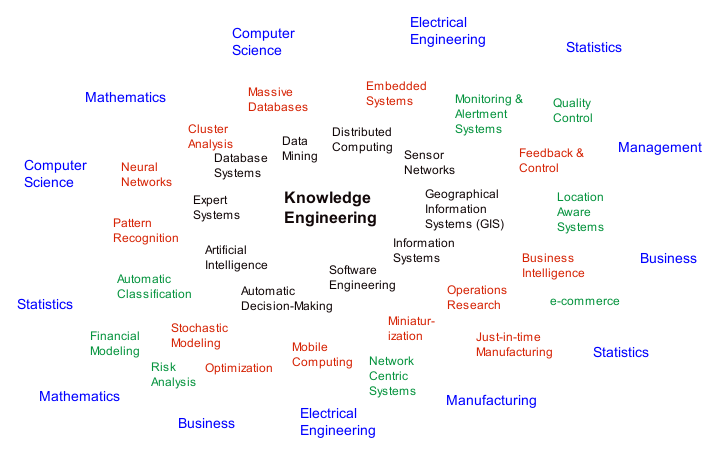 Traditional science and technology disciplines are in the outermost ring, often isolated from each other. The result of their integration is driving the areas out of which a large portion of technology in the coming decades is likely to appear.
Mathematical Finance is an area of applied mathematics that has developed rapidly during the late 80s and 90s after the deregulation of U.S. financial markets, and accelerated further in the 2000s concurrently with the rise of data science/’big data’ and computational platforms able to run complex models in close to real-time. For its financial models for risk and pricing, Mathematical Finance draws upon the partial differential equations of mathematical physics, stochastic calculus, probabilistic modeling, mathematical optimization, statistics, and numerical methods. The implementation of these often complex numerical mathematical models requires efficient algorithms and exploiting the state-of-the-art in software engineering (real-time and embedded development, low latency network programming) and computing hardware (FPGAs, GPUs, and parallel and distributed processing). Taken together, the technical aspects of mathematical finance and the software/hardware aspect of financial engineering lie at the intersection of business, economics, mathematics, computer science, physics, and electrical engineering. For the technologically inclined, there are ample opportunities to contribute. But the relevance goes beyond mathematics. There is a kernel of core financial ideas that are at the heart of the global free market capitalist system that is in place across most of the world today. These ideas affect not only economics but also politics and society. Ideally, every citizen in a democracy should understand the essential mechanics of the modern financial world and how it has arisen, regardless of whether we agree with its principles or with the impact of the financial system on social structures. This article presents a simplified account of the rise of the modern financial marketplace including some history, and contemporary financial context. Update (2012): A highly recommended graphic novel Economix, by Michael Goodwin has just been published that presents a panoramic yet highly accessible narrative.) TinyPhoto is a small rotating photobook embedded graphics project that uses the low-power ATtiny85 microcontroller (3mA) and a 128×64 pixel OLED display (c.5-10mA typical, 15mA max). This combination can deliver at least 20 hrs of continuous play on a 3V coin cell battery (225mAh capacity). TinyPhoto can be readily built from a handful of through-hole electronic components (12 parts, £5) organized to fit onto a 3cm x 7cm single-sided prototype PCB. The embedded software is c.150 lines of C code and uses less than 1,300 bytes of on-chip memory. TinyPhoto rotates through five user-selectable images using a total of 4,900 bytes (yes, bytes!) stored in the on-chip flash RAM. The setup produces crisp photos on the OLED display with a real-time display rate that is instantaneous to the human eye with the Tiny85 boosted to run at 8MHz. A custom device driver (200 bytes) sets up the OLED screen and enables pixel-by-pixel display. Custom Forth code converts a 0-1 color depth image into a byte-stream that can be written to the onboard flash for rapid display. It is a reminder of what can be accomplished with low-fat computing… The magic, of course, is in the software. This article describes how this was done, and the software that enables it. Checkout the TinyPhoto review on Hackaday!  Tiny Photo – 3cm x 7cm photo viewer powered by ATTiny85 8-bit microcontroller sending pixel level image data to OLED display (128×64 pixels), powered by 3V coin cell battery. Cycles through 5 images stored in 5kB of on-chip Flash RAM. (Note, this is 1 million times less memory than on a Windows PC with 8GB RAM). The magic is in the software. Voice controlled hardware requires four capabilities: (1) vocal response to trigger events (sensors/calculations-to-brain), (2) speech generation (brain-to-mouth), (3) speech recognition (ear-to-brain), and (4) speech understanding (brain-to-database, aka learning). These capabilities can increasingly be implemented using off-the-shelf modules, due to progress in advanced low-cost silicon capable of digital signal processing (DSP) and statistical learning/machine learning/AI. In this article we look at the value chain involved in building voice control into hardware. We cover highlights in the history of artificial speech. And we show how to convert an ordinary sensor into a talking sensor for less than £5. We demonstrate this by building a Talking Passive Infra-Red (PIR) motion sensor deployed as part of an April Fool’s Day prank (jump to the design video and demonstration video). The same design pattern can be used to create any talking sensor, with applications abounding around home, school, work, shop, factory, industrial site, mass-transit, public space, or interactive art/engineering/museum display.  Bringing Junk Model Robots to life with Talking Motion Sensors (April Fools Prank, 2021) Abstract This brief note explores the use of fuzzy classifiers, with membership functions chosen using a statistical heuristic (quantile statistics), to monitor time-series metrics. The time series can arise from environmental measurements, industrial process control data, or sensor system outputs. We demonstrate implementation using the R language on an example dataset (ozone levels in New York City). Click here to skip straight to the coded solution), or read on for the discussion.  Fuzzy classification into 5 classes using p10 and p90 levels to achieve an 80-20 rule in the outermost classes and graded class membership in the inner three classes. Comparison with crisp classifier using the same 80-20 rule is shown in the bottom panel of the figure.
In Section 7, we implement the grammar of the statement calculus in the Symbolic Logic Simulator (SLS), a program written in 28 lines of Forth code, that allows computer-aided verification of any theorem in Propositional Logic (see Appendix 1 for source code). The program makes it straight-forward to explore non-obvious logical identities, and verify any propositional logic theorem or conjecture, in particular see Appendix 2 for key identities in the statement calculus (duality, algebraic, and canonical identities). The concept of linguistic adequacy is developed in Section 8 and the NAND Adequacy Theorem is proved showing that NAND can generate all logical operations. A corollary is that any digital logic circuit can be built up entirely using NAND gates, illustrated using the free Digital Works software. In this article we look at the ideas of George Peacock whose 700-page opus A Treatise on Algebra (1830) transformed classical algebra into its modern form as an abstract symbolic science, free from the physical interpretation of quantity that had previously restricted it. The rise of Mathematical Logic: from Demonstration to Laws of Thought to Foundations for Mathematics
In this article we look at the evolution of logic from its earliest form in the demonstration of truths to the rapid development of mathematical logic in the 1800s at the start of the “golden century” of logic (1850-1950). We also look at the rise and surprising dashing of hopes for the formalist program. This is Part 3 in the Ancient Mathematics series. (To read earlier parts: Part 1: Prehistoric Origins of Mathematics, Part 2: The Mathematics of Uruk and Susa). This article explores what the people of Mesopotamia wrote about, counted and produced in the last part of the fourth millenium BCE. It does so by examining the frequency of signs in the proto-cuneiform tablets from the period c.3500-3000 BCE. For those wishing to build up experiential understanding of life in the Neolithic and early Bronze Age near east, this article provides suitable references as well as practical explorations of the economic and productive activities of the people: rope-making from grass, basket-weaving from reads, baking, weaving of cloth from linen, breaking ground, sowing, reaping, making flour, etc. The first part of the article look closely at the collection of artifacts in each period that are associated with the evolution of writing and mathematics in ancient Mesopotamia, examining noteworthy individual artifacts that showcase a key development. The study uses the CDLI database of cuneiform documents, and software I’ve written that parse the files in the CDLI database, extracting counts, parsing signs, generating frequency distributions of signs, creating a proto-cuneiform glossary, and assisting in the quantitative analysis of artifacts and semi-automated translation (see CDLI parser software library written in Ruby). Before domain-specific languages (DSLs) and REPL environments (read, execute, print, loop) became fashionable, computing pioneer Charles (Chuck) Moore had built, by 1968, what he viewed as the perfect computer programming language, which he named FORTH (for fourth generation language). What he had kept in view during its creation was an extreme austerity in syntax and structure as he searched for the minimalist system required to interact with a computer and be able to write custom problem-oriented languages to solve them. This approach is what he considered to be “programming”: you solve your problem by developing an application specific language with multiple levels of abstraction giving you in the end a small dictionary of simple words (in code) which represents the solution cleanly and in overall the fewest lines of code. Let’s look at this idea, how it has worked out over the years, and how you can apply this, regardless of the language you choose to (or have to) work with. This article looks at Forth, Lisp & Ruby, language that make it easy to solve classes of problems by writing your own DSL, i.e. by programming a specific “problem-oriented language” in which to solve your problem. This is Part 2 in the Ancient Mathematics series. (Part 1: The Prehistoric Origins of Mathematics, Part 3: Exploring Cuneiform Culture 8500-2500 BCE) Summary The written mathematics of ancient Iraq and Iran (Mesopotamia, Khuzistan) developed out of an administrative/bureaucratic program to control the surplus raw and manufactured goods of the settled societies of the late neolithic/early bronze age: grains & grain products, sheep & other herded animals, jugs of dairy fats & beer, rope & textiles. It evolved through a sequence of literary and mathematical innovations, each making more efficient the ability to record quantitative/metrological information and use it for planning and control. Initially, impressed tokens and pictographs were used whose meaning was clear by association. Subsequently, this repertoire was written signs was expanded in a consious effort to provide a standard, all-encompassing collection of signs/symbols (ideographs/logograms) that could represent all aspects of importance in early thought (professions, animals, foods, containers, textiles, etc.). The standard sign lists were spread through scribal schools to produce the scribes that administered the temple economies of the early city-states. Uruk was the hegemonic centre of this innovation in mathematics and writing, starting from 3500 BCE. The increased administrative control generated economic efficiencies accelerating Uruk’s growth and which supported greater military effectiveness and the ability to dominate neighboring polities and support longer distance trading missions [Adams/2005], [Algaze/2013]. The success of Uruk’s structures had the effect of radiating the new inventions outward throughout the Greater Mesopotamian region (evidence in Aratta/Susa adoption of writing/adminstrative control), even reaching Anatolia (Turkey) in the far north (Uruk expansion phenomenon). The gains in economic power and increased resilience to subsistence unpredictability conferred by the new planning and control capabilities, set in motion the development of a bureaucratic administrative culture in the southern Mesopotamian city states that, over the next 1000 years would reach its hypertrophic apex in the ambitious Ur III program under King Shulgi to plan, manage, and control all economic/productive assets in his vast empire through mathematics (c.2050 BCE). This required an army of scribes which in turn led to the standardization and systematization of the scribal school institution responsible for producing them. Two examples of mathematical innovation are from the cattle redistribution center Puzrish-Dagan outside Nippur during the Ur III empire. One shows perfection of the form of tabular accounting (world’s earliest normalized two-dimensional table with rows and columns and sums in both dimensions) [Robson/2003]. The other shows the population growth modeling of a cattle-herd over 10 years with projected economic yields in dairy and cheese, solving, in modern terms, population difference equations in table form (see illustrated explanation of cuneiform tablet TCL 2, no.5499, [Nissen/1993: 97-102]) In this paper, we will look in more detail at mathematical development during the archaic period of writing (3500-3000 BCE) which gave rise to a new literate and quantitative layer in society in the main urban centres of Mesopotamia. Our thesis (which we have seen play out already in Part 1) is that technology (in this case mathematics/writing) and culture (in this case the impulse to plan/control) are inextricably linked. Their development influences the trajectory of the surrounding societies.1  Ur III mathematical model projecting annual dairy/cheese yields from a herd of 4 cows and a bull with assumptions on calving rates Continue reading this article…
Rapid prototyping can be an accelerator for hardware or embedded solutions. But for a successful outcome, follow the recommended checklist / task sequence given below, as all of these steps will likely need to be touched upon at some point in the process. For under £10, you can put together a microcontroller development platform, ready to program directly from your PC over USB using free Arduino software. Once programmed, your microcontroller will run autonomously, untethered from your PC, powered by as small a battery power supply as a single 1.5V AAA or 3V CR2032 coin cell. You can have it interact with its environment using dozens of low-cost sensors and motors. Everything you need to explore the exciting world of embedded systems is available to you, typically for less than a day pass on the London underground.  A homebrew Arduino Nano microcontroller development kit for under £12 (including optional OLED display) If you haven’t done so already, you may want to start by reading the Preface to the Computing Series: Software as a Force Multiplier, Sections 1-3. “Everything” you need for ultra-fast desktop search1. Everything(tm) is an ultra-fast desktop search utility that can scan through hundreds of thousands of files in milliseconds using a pre-built and real-time updated index.“Everything” brings order to information growing at scale (documents, photographs, source code, spreadsheets, etc.), and tames the problem of proliferating folder trees.  Everything is a fast desktop search utility that can index 1 million files in less than 1 minute, and generate search queries in milliseconds. We’ve all been in the scenario of searching through electronic documents for a document you know you prepared three, maybe four weeks prior… maybe it was longer… and now you can’t remember where you saved it… or in what format: was it a quickly written text file, a word document, a few paragraphs within One Note, on a desktop post-it note, or did you email yourself from your phone?… After trying different Windows searches in various recently used folders and looking through Word, Excel, and PDF files, and trying to remember possible filenames to search for, at some point you prepare mentally for the moment when you will give up the search and attempt to redo the missing work, salvaging as much of it as you can remember. The general problem of wasted effort locating information we know we have, occurs more often than we’d like to admit. With “Everything“, it can be better. If you haven’t done so already, you may want to start by reading the Preface to the Computing Series: Software as a Force Multiplier, Sections 1-3. 1. Notepad++: a programmable, extensible, feature-rich text editorNotePad++ (NPP) is an open-source programmer’s text editor with outstanding built-in features that can be further enhanced with powerful plugins and extensively customized with your own configurations. NPPs features include syntax highlighting for a large collection of programming languages, code folding, recordable macros, cloned views, selectable shortcuts, tabbed documents, and a host of other capabilities. This article describes a few of the dozens of capabilities. It also shares a pre-configured Notepad++ package that I use (20.0MB compressed, 50.0MB uncompressed, download here), which contains the configurations and capabilities I use. The file is portable and self-contained: just unpack NPP to your drive (in a separate folder to your current running instance) and run notepad++.exe from there.1 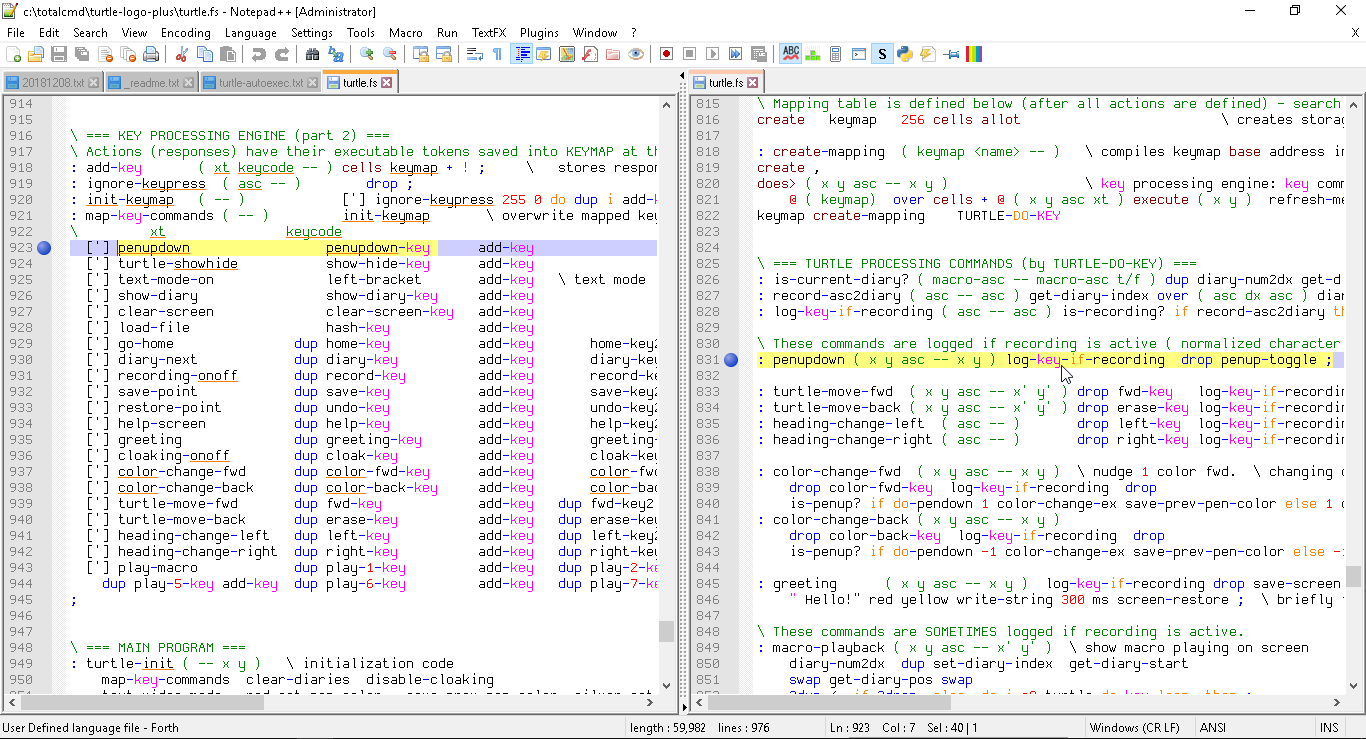 Notepad++, by Don Ho, multi-view with syntax highlghting Continue reading this article…
If you haven’t done so already, you may want to start by reading the Preface to the Computing Series: Software as a Force Multiplier, Sections 1-3. 1. Total Commander: a programmable, extensible, feature-rich two-panel orthodox file managerTotal Commander (TC) is more than just a two-panel orthodox file manager for Windows. It is a swiss army knife of computing utilities and is the first piece of software that I install on any Windows computer on which I’m working.1 Total Commander, used well, is a force multiplier.
I’ve been using TC continuously since 2001. Over the years, I’ve put together a Total Commander Expansion Pack (lite and full) for the TC platform that conforms to the tenets and further extends TC platform’s capabilities with tools I have found valuable. Both are pre-configured downloads to allow unpack and start using with minimum fuss (I use them when switching computers). Feel free to download and give them a try. Feedback or questions welcomed in the comments.  Total Commander Expansion Pack Winter 2024 – Toolbar View with Integrated Applications, Download from link. Continue reading this article…
|
||||
|
© 2009-2026 Assad Ebrahim To contact me on email, use: assadebrahim2000 at gmail dot com (do the obvious) |
||||

